
The Great Data Centre Gold Rush, Why Traditional Builders Are Out of Their Depth
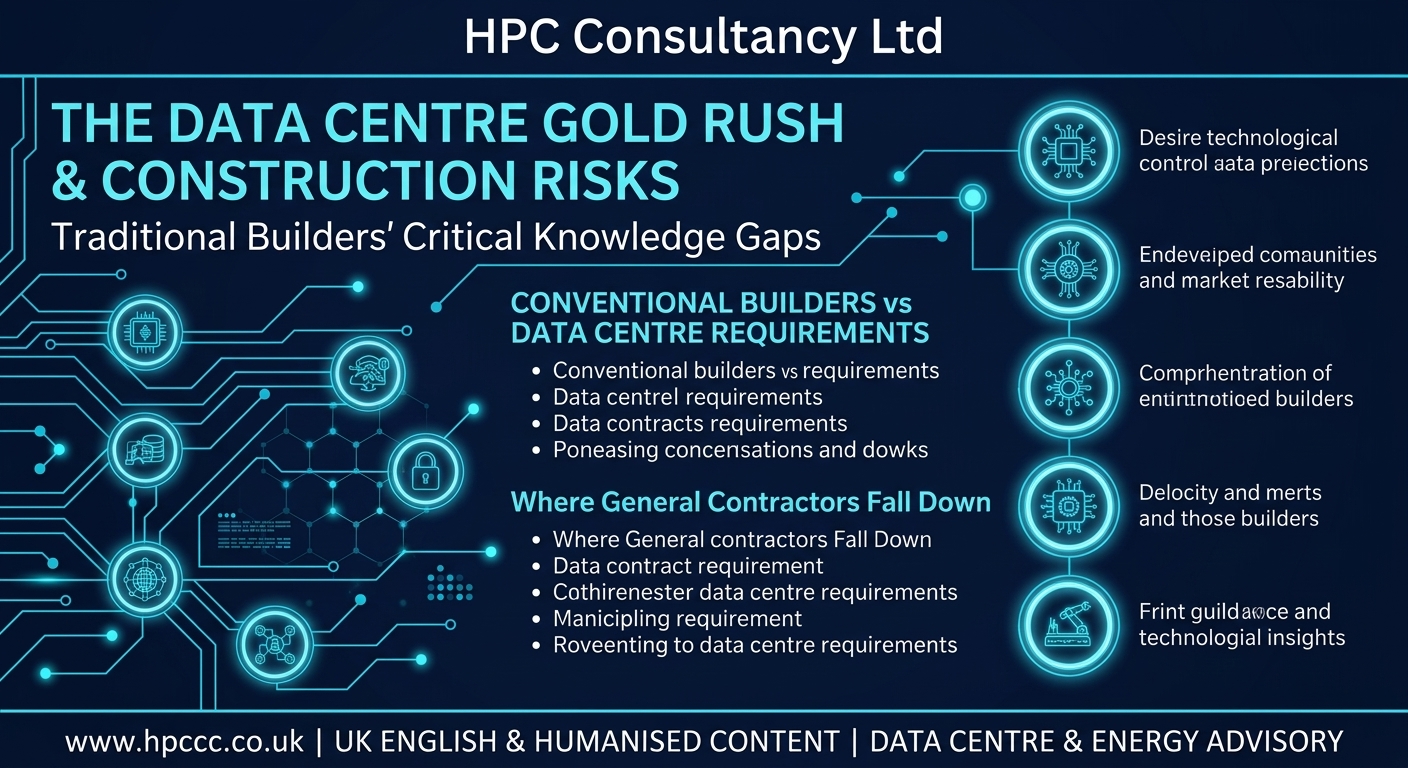
The boom in artificial intelligence, cloud computing, and heavy enterprise processing has kicked off an unprecedented scramble for data centres. Right across the industry, construction firms and developers who spent decades laying horizontal infrastructure, building civil works, or erecting commercial high-rises are pivoting towards digital assets.
Building a mission-critical data facility is a different beast entirely. It takes far more than pouring heavy concrete slabs or bolting together structural steelwork; it requires deep, specialized engineering across site selection, grid integration, dynamic cooling, and future-proof scalability.
At HPC Consultancy Ltd, we view this rapid influx of general contractors with genuine concern. Constructing a high-density compute facility requires specialized domain knowledge that traditional builders simply do not possess. Getting your site parameters, power access, or thermal management wrong leads directly to stranded assets, astronomical budget overruns, and catastrophic operational downtime.
The Fatal Disconnect in Conventional Construction
Standard construction frameworks collapse when applied to mission-critical compute infrastructure. Commercial property developers naturally design around floor space, tenant amenities, and architectural aesthetics. Data centres, by contrast, are specialized, high-density power plants built to house sensitive, high-value compute hardware.
+-----------------------------------------------------------------------------------+
|                  CONVENTIONAL BUILDERS VS DATA CENTRE REQUIREMENTS                |
+-----------------------------------------------------------------------------------+
|                                                                                   |
|  CONVENTIONAL CONSTRUCTION         -->  MISALIGNED DESIGN & INFRASTRUCTURE       |
|  * Focus on floor space & aesthetics    * Neglects power grid substation lead times|
|  * Standard HVAC systems                * Ignores agentic AI thermal densities    |
|  * Linear scaling frameworks            * Fails high-density rack scalability     |
|                                                                                   |
+-----------------------------------------------------------------------------------+
|            RESULT: COST OVERRUNS, STRANDED ASSETS & OPERATIONAL FAILURE          |
+-----------------------------------------------------------------------------------+
Where General Contractors Fall Down
-
Blind Spot Site Selection. Buying plots based purely on land price or transport links, without auditing local grid capacity, fibre route latency, or flood plain risks, leaves developers with unusable land.
-
Outdated Power and Thermal Planning. Standard building HVAC systems cannot cope with modern compute clusters. High-performance AI workloads generate intense heat loads that demand direct-to-chip dynamic liquid cooling architectures.
-
Rigid Design Architecture. Building rigid floor layouts without built-in structural flexibility creates immediate bottlenecks when tenants upgrade from standard rack setups to high-density AI hardware.
5 Critical Pillars Contractors Must Get Right
If construction firms want to successfully deliver data centre projects without facing operational failure, they need to master five core technical pillars:
-
Strategic Land Acquisition, Feasibility, and Site Selection. Before exchanging on land, developers must verify power substation proximity, transmission line latency, cooling water availability, environmental risks, and local sovereign data legislation. Rigorous feasibility studies and technical audits are essential to ensure the plot actually supports long-term operational demands.
-
High-Density Rack Design with Power and Cooling Optimisation. Modern AI workloads require extreme energy density per rack. Construction plans must integrate specialized power distribution units, high-voltage components, and dynamic liquid cooling loops to prevent thermal throttling.
-
Technical Auditing, Feasibility Studies, and Build-Out Advisory. Independent technical auditing guarantees that structural, mechanical, and electrical designs strictly meet Tier III and Tier IV facility standards long before contractors break ground.
-
Sovereign Compute Compliance and Hybrid Cloud Integration. Physical assets and internal wiring must align with strict national data governance frameworks, local data protection laws (such as the EU AI Act or Saudi PDPL), and hybrid cloud connectivity requirements.
-
Edge Architecture Development and Latency Optimisation. Facilities must incorporate edge computing capabilities to cut latency for real-time applications, gaming platforms, and media streaming networks, striking a balance between centralized compute hubs and localized edge nodes.
Strategic Advisory with HPC Consultancy Ltd
HPC Consultancy Ltd offers specialized technical advisory, site selection auditing, and infrastructure strategy for institutional investors, data centre operators, and commercial developers looking to enter the market safely.
-
Entity. HPC Consultancy Ltd
-
Advisory Services. Data Centre Feasibility, Site Selection Auditing, High-Density Power and Cooling Strategy, Tier Infrastructure Advisors
-
Primary Domain. www.hpccc.co.uk